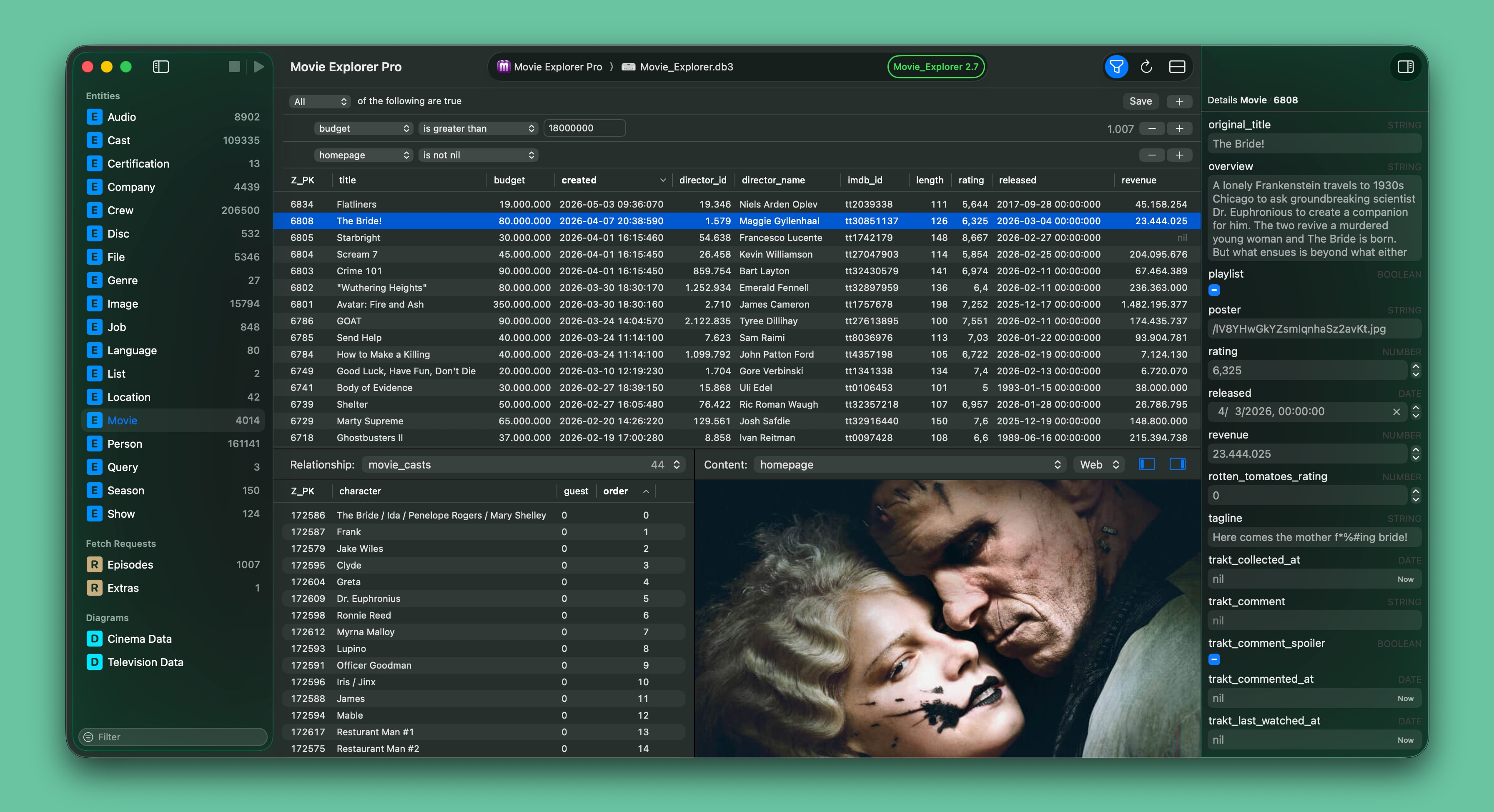
Core Data Lab 3.1: Golden Gate support
Core Data Lab 3.1 improves compatibility with macOS 27 in multiple ways. A lot of smaller adjustments have to do with some subtle AppKit bugs. However, most changes are related to the “New Features” of System Integrity Protection in macOS 27. This affects only users who use the Search Database function. It required quite some effort to keep the feature working in macOS 27, hence all the prose below.
Overview System Integrity Protection changes
Normally, sandboxed apps can’t access files outside the app’s sandbox. To get access to a file or folder, the sandboxed app must initiate a user interaction. For example, presenting a NSOpenPanel, to retrieve a security-scoped bookmark for a certain file location. This is also what Core Data Lab does, the first time you open the Search Database function. A NSOpenPanel is presented to select a folder that acts as a search path. The bookmark of this selection is stored by Core Data Lab in NSUserDefaults, for future reuse.
Since macOS 15, a valid folder bookmark is not sufficient anymore to open files located in the folder or subfolders, if the folder is (a subfolder of) one of the two official sandbox app container folders, ~/Library/Containers or ~/Library/Group Containers. System Integrity Protection (SIP) in macOS 15 and macOS 26 displays a confirmation dialog each time an app tries to access data from other developer teams located in one of the two app container folders. It is even possible in Xcode to configure the text that is being displayed by said dialog.
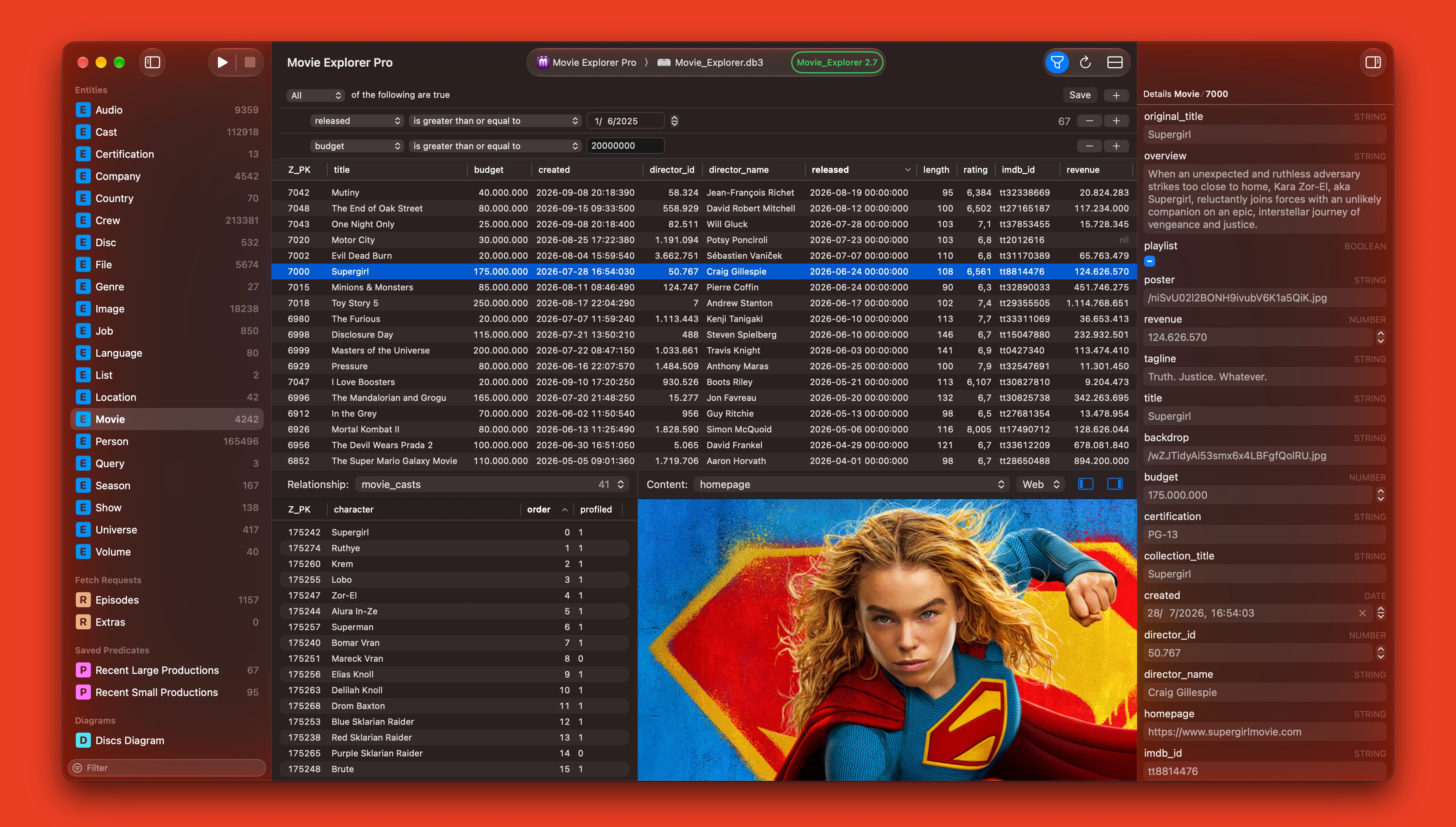
Core Data Lab 3.0: Favorites, diagrams and more
Core Data Lab 3.0 adds support for Liquid Glass, introduces the concept of ‘Favorite attributes’ and ‘Favorite content’, adds a Relationships panel to the Object editor window, lets you visualize your data model with diagrams, plus a lot of other improvements.
Liquid Glass
Unlike the previous major overhaul of the macOS user interface with macOS Big Sur, which turned out to be more or less acceptable after a few months of use, the current macOS Tahoe release, which is now on version 26.5, still gives the impression that the user interface design implementation needs seriously more finetuning, mainly due to all the issues with contrast and readability. Despite all that, we have done our best to embrace and implement the concepts of the Liquid Glass design in Core Data Lab 3.0, although with a few tweaks here and there to improve the contrast in especially dialogs.